Predict
Estimate the final sample from the current state and pretrained velocity.
Pretrained flow models provide powerful generative priors for scientific and image inverse problems, but their samples must also satisfy constraints supplied at inference time. LyapuFlow guides generation with Lyapunov feedback: at each sampling step, it predicts the terminal sample, measures its constraint violation, and computes the smallest correction needed to meet a prescribed decrease condition. The controller stays inactive when the original flow already makes sufficient progress, and a trust region keeps corrections from overwhelming the pretrained dynamics. Experiments in data and latent spaces show improved sample fidelity with competitive constraint satisfaction, without retraining the generative model.
LyapuFlow adds inference-time feedback to a pretrained flow model. It evaluates constraints on a predicted final sample, then chooses a minimum-norm correction using a Lyapunov decrease condition. A trust region limits the correction relative to the learned flow. No retraining is required.
Estimate the final sample from the current state and pretrained velocity.
Measure the predicted sample’s constraint violation.
Apply bounded feedback only when the nominal dynamics need correction.
Results · Data space
LyapuFlow guides generation under physical constraints across heat, Burgers, and reaction–diffusion equations.
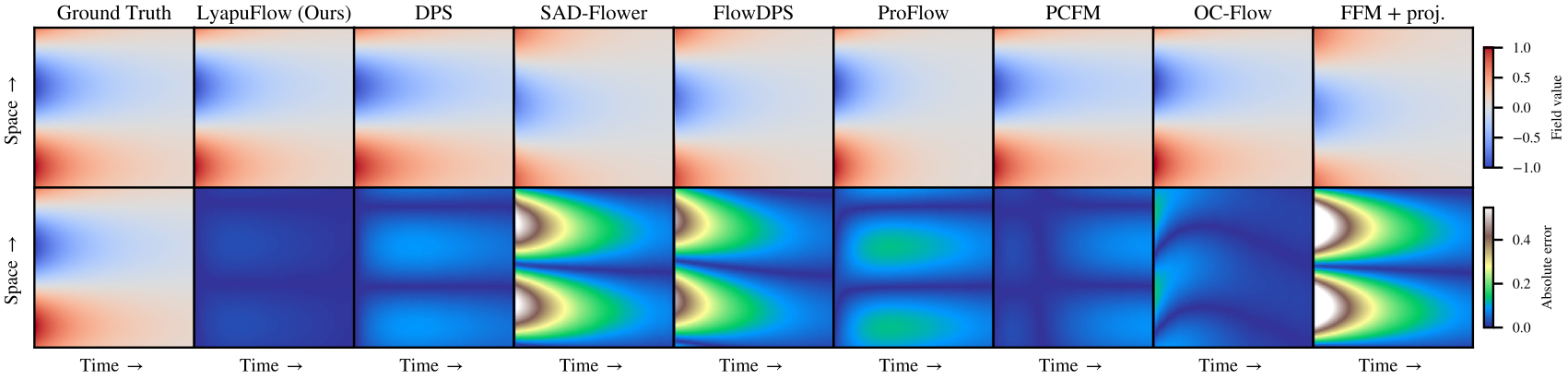
Under initial-condition and conservation-law constraints, the heat-equation examples compare generated fields and their absolute errors across guidance methods.
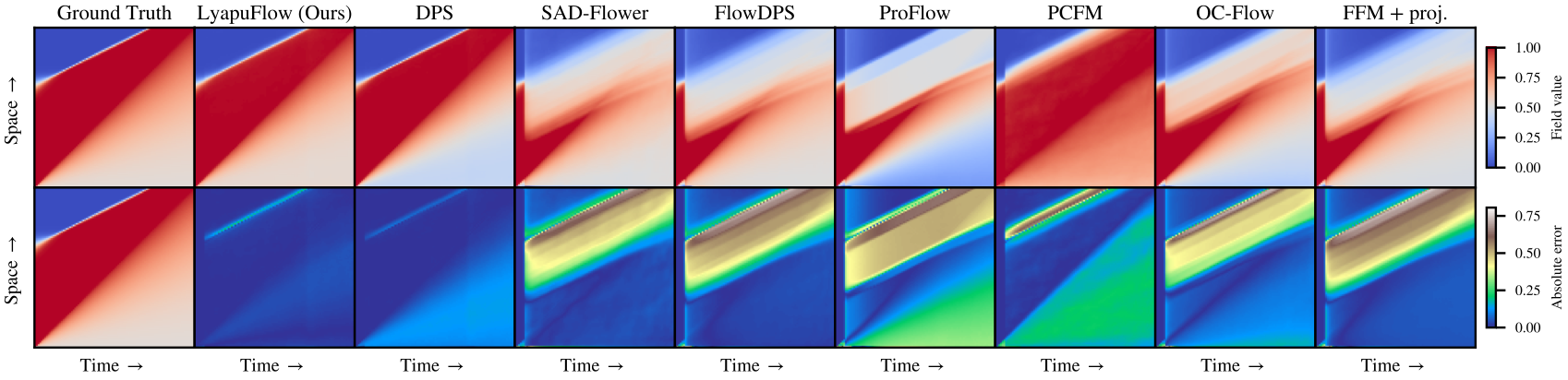
The Burgers examples show average generated solutions and pointwise absolute error under initial-condition, local-dynamics, and conservation constraints.
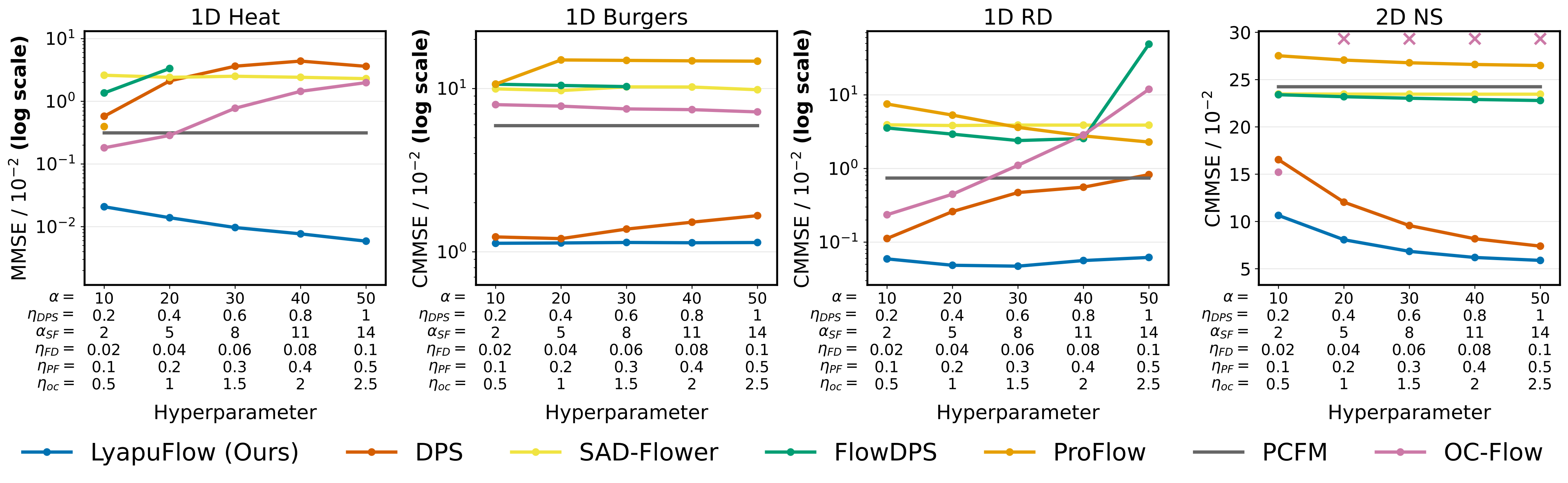
The comparison shows how seven PDE samplers respond to their main guidance hyperparameters.
Results · Latent space
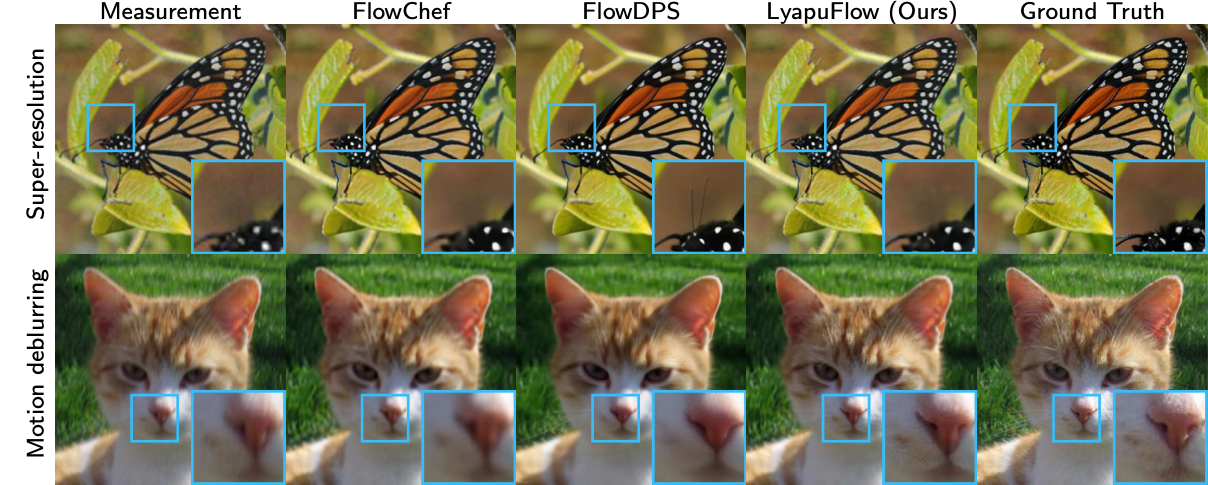
Latent-space experiments study super-resolution and deblurring while keeping reconstructions consistent with the measurements.
Super-resolution and motion-deblurring examples compare the measurement, competing reconstructions, LyapuFlow, and ground truth. Enlarged regions make fine-detail differences easier to see.
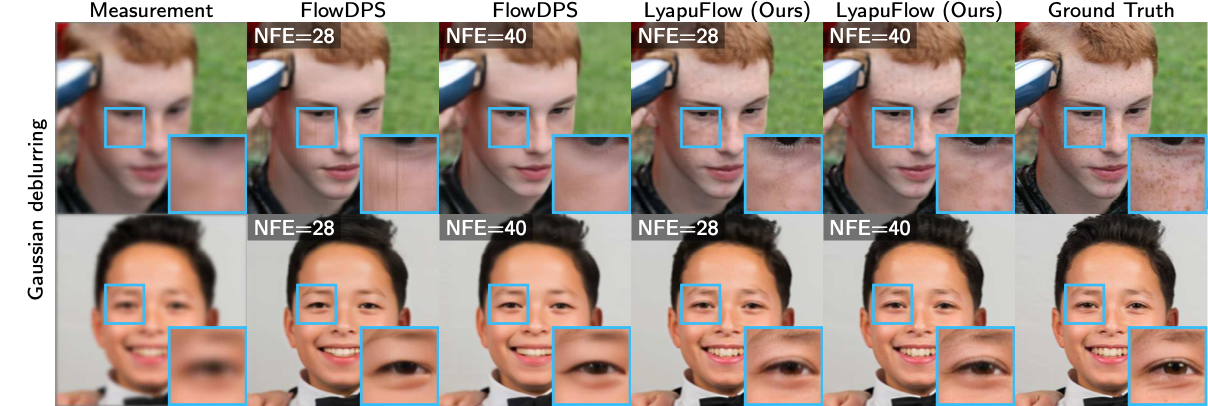
Gaussian deblurring reconstructions compare FlowDPS and LyapuFlow at 28 and 40 function evaluations, showing how the restored details change with the sampling budget.
@article{lyapuflow,
  title={LyapuFlow: Controlling Generative Flows with Lyapunov Feedback for Inverse Problems},
  author={Gwak, Minseon and Hsu, Hans Hao-Hsun and Maddix, Danielle C. and Erichson, N. Benjamin},
  journal={arXiv preprint arXiv:2610.04326},
  year={2026}
}